ExtensionsFree
Player Manager
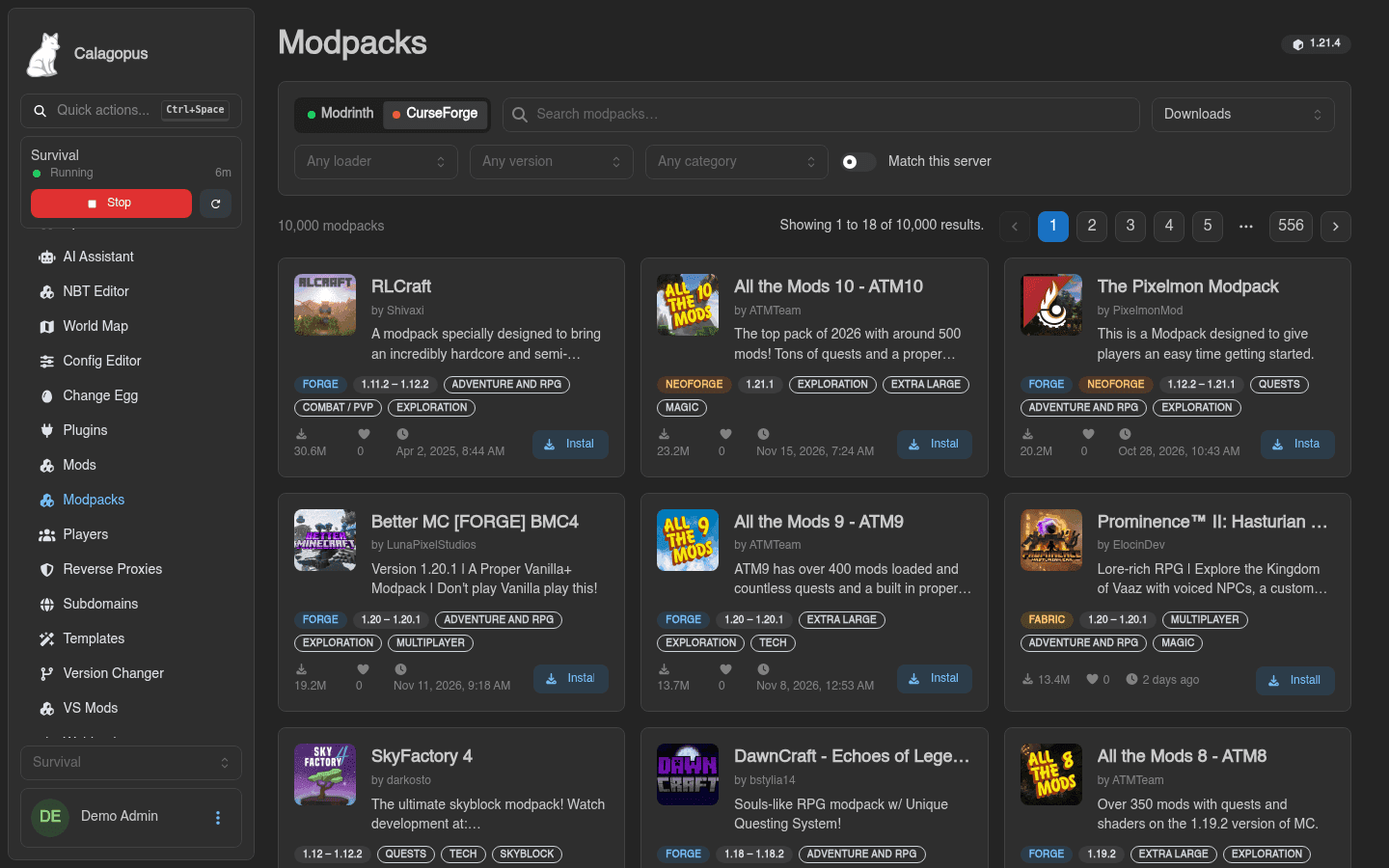
by CaloptreyxCalagopus extension: manage players of Minecraft Java and Bedrock servers (online players, whitelist, operators, bans).
No ratings yet
Reverse Proxy via Nginx Calagopus extention
Reverse Proxy via Nginx Calagopus extention
Reverse Proxy Manager A Calagopus Panel extension that lets users put a domain in front of one of their server's ports through Nginx Proxy Manager or NPMplus, with automatic Let's Encrypt certificates. Users add their own domain (or pick a managed subdomain), choose a port, done. Package name: dev.caloptreyx.reverseproxy · Requires panel >=1.2.10 · Tested with Nginx Proxy Manager 2.15 (2.10+ supported) and NPMplus 2026-07-24-r1 plus its September 2026 development builds (the flavor is detected automatically) What your users get • Custom domains or managed subdomains, pointed at any of the server's allocations • Automatic HTTPS with Let's Encrypt, their own uploaded certificate, or plain HTTP only • WebSockets, caching, HTTP/2, HSTS, force-HTTPS and exploit blocking per proxy • Optional custom nginx snippets (admin opt-in, allowlisted directives) • Clear status at a glance - live, issuing, waiting for DNS or failed with a readable reason • Retry themselves instead of opening a ticket What you get • Per-server proxy limit (featurelimits.proxies), allowed domain suffixes and blocked patterns • Granular permissions and full activity logging • Fleet view of every proxy across every server, with a failing count • Reconcile tool to spot and fix drift between the panel and the proxy • Per-node forward host overrides for NAT'd nodes • Let's Encrypt rate-limit protection: DNS is checked before a certificate is requested, attempts are capped (10 per hour, 3 per domain per week), failures back off, and existing certificates (including wildcards) can be reused - so bad DNS can't burn your quota • Never touches proxy hosts or certificates it doesn't own: every host it creates carries an ownership marker that is checked before any change Automated • A background worker issues certificates one at a time and retries with backoff • A background sync keeps the proxy in step with the panel, fixes drift, tracks certificate expiry, renews certificates NPM failed to renew and cleans up orphans it owns • Deleted servers take their proxies with them; removed ports disable the proxy until a new port is chosen; transfers update the forward target • Remote deletions that fail are queued and retried Subdomain Manager integration With the Subdomain Manager extension installed and enabled, users can create proxies directly on your managed domains. DNS records are created automatically, Cloudflare zones use DNS-01 validation with the zone's API token, and reserved names and existing subdomains are respected. Installation Download devcaloptreyxreverseproxy.c7s.zip from the latest release and either upload it under Admin → Extensions or drop it into your heavy image's build/extensions/ directory and docker compose restart web. Extensions require the :heavy panel image - see the Calagopus docs. Configuration Admin → Extensions → Reverse Proxy Manager → Configure 1. Create a dedicated user in Nginx Proxy Manager with permission to manage proxy hosts and certificates. Give it a real email address - Let's Encrypt uses it for the account - and keep two-factor authentication off for it. 2. Enter the NPM URL as reachable from the panel (e.g. http://npm:81 or a VPN address), the user's email and password, and press Test Connection. NPMplus: use an https:// URL (e.g. https://npmplus:81) and turn on Accept self-signed certificate unless you gave NPMplus a trusted certificate via DEFAULTCERTID. New NPMplus users start with every permission hidden - set proxy hosts and certificates to manage (access lists at least view). NPMplus registers the Let's Encrypt account with its ACMEEMAIL, so the user's email doesn't matter. It always enables WebSockets and HTTP/2 and has no caching or exploit blocking, so those proxy options have no effect there. 3. Set the DNS target: the public IP or hostname of the NPM server. Users are told to point their domains here, and HTTP-validated certificates are only requested once a domain resolves to it. 4. Give servers a proxy limit (default for new servers in the settings, or per server under feature limits). Tabs: • Settings - connection, certificates, domain rules, user permissions, defaults for new proxies and the background sync • Nodes - forward host overrides for nodes behind NAT or on a private network • Proxies - every proxy on the panel, with status filter, retry and delete • Reconcile - compare the panel with NPM and fix drift, plus the queue of pending remote deletions Permissions: server proxies.read|create|update|delete, admin proxies.read|manage. Custom nginx snippets With Allow custom nginx configuration on, users can add a snippet to each proxy. Only these directives are accepted; anything else is rejected. Snippets can't read or write files on the NPM host (root, alias, include, store, log, ssl, Lua/JS/Perl, ...), and they can't send requests anywhere but the server's allocation: proxypass and the other pass directives, upstream, resolver, subrequests (mirror, authrequest, errorpage, SSI) and set (NPM's default location proxies to the $server/$port variables) are all refused. • blocks: location, if • headers: addheader, addtrailer, moresetheaders, moreclearheaders, moresetinputheaders, moreclearinputheaders, proxysetheader, proxyhideheader, proxypassheader, proxyignoreheaders, proxycookiedomain, proxycookiepath, proxycookieflags, proxyredirect, realipheader, setrealipfrom, realiprecursive, ignoreinvalidheaders, underscoresinheaders, servertokens • proxying (to the server's allocation only): proxyhttpversion, proxymethod, proxysetbody, proxypassrequestbody, proxypassrequestheaders, proxyintercepterrors, proxynextupstream, proxynextupstreamtimeout, proxynextupstreamtries, proxysslname, proxysslservername • timeouts and buffering: proxyconnecttimeout, proxyreadtimeout, proxysendtimeout, proxybuffering, proxybuffersize, proxybuffers, proxybusybufferssize, proxyrequestbuffering, proxymaxtempfilesize, clientmaxbodysize, clientbodybuffersize, clientbodytimeout, clientheaderbuffersize, clientheadertimeout, largeclientheaderbuffers, keepaliverequests, keepalivetimeout, sendtimeout, chunkedtransferencoding • content: gzip, gzipcomplevel, gzipdisable, gzipminlength, gzipproxied, gziptypes, gzipvary, subfilter, subfilteronce, subfiltertypes, subfilterlastmodified, charset, defaulttype, expires, etag, ifmodifiedsince • access and rewrites: allow, deny, satisfy, return, rewrite, break Snippets are parsed the way nginx parses them, so quoting a directive name or hiding it behind a comment doesn't get past the check, and a snippet must be complete (closed quotes, braces and statements). A location block in a snippet doesn't proxy (it can't use proxypass), so it is only useful for return or deny rules. Stored snippets that no longer pass (for example ones with proxypass or set, allowed up to v0.1.5) are left out when the proxy is pushed to NPM. Screenshots Server page: users see where to point their domain before adding a proxy. Create Reverse Proxy: domain, port, certificate and options. Admin settings API • GET|POST /api/client/servers/{server}/reverse-proxies, PATCH|DELETE .../reverse-proxies/{proxy}, POST .../reverse-proxies/{proxy}/retry • GET|PUT /api/admin/extensions/dev.caloptreyx.reverseproxy/settings, POST .../connection/test • GET .../proxies, POST .../proxies/{proxy}/retry, DELETE .../proxies/{proxy} • GET .../nodes, PUT .../nodes/{node} • GET .../reconcile, POST .../reconcile/fix, GET .../cleanup, DELETE .../cleanup/{task} Full schemas are in the panel's OpenAPI document once installed. Support Need help or want to request a feature? Join the Caloptreyx Discord. License MIT
Calagopus extension: manage players of Minecraft Java and Bedrock servers (online players, whitelist, operators, bans).

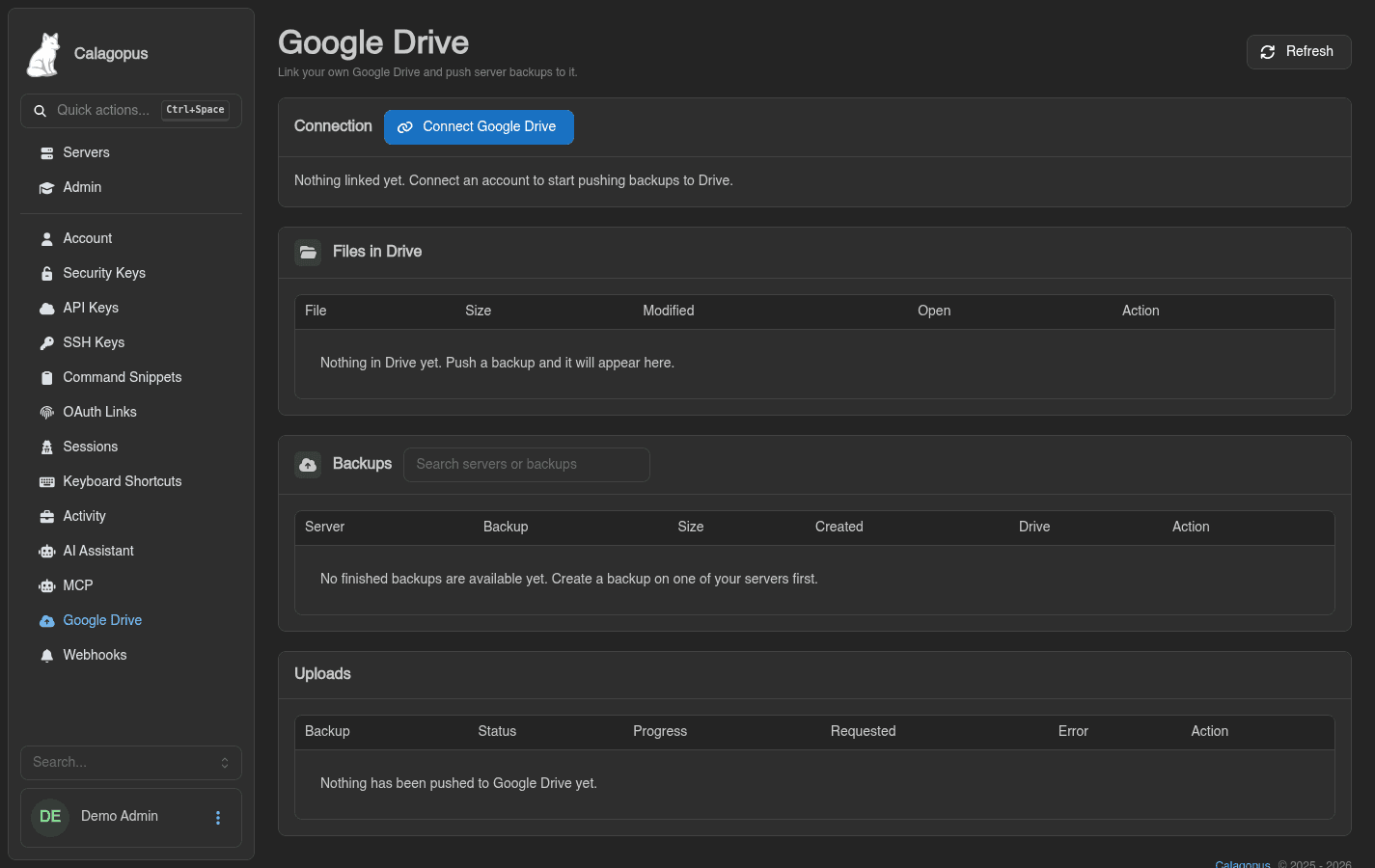
An extension for Calagopus that allows users to backup their servers to Google Drive